From Prehistory to Protohistory
The Bibione area, even before the appearance of man, was formed by the saltwater of the Adriatic and the freshwater of the Tagliamento River. It was characterized by a vast expanse of forest that covered the entire area from the mountains to the sea.
During the early Tertiary period, the waters of the Adriatic Sea reached almost to the Alps, forming a large gulf. With climate change, the sea level began to recede, only to rise again during interglacial periods. Humans began to live on these lands, initially without fixed abodes, trying to survive by hunting and fishing. But from the end of the 5th millennium BC, they began to practice agriculture, thus forming the first villages. Thus arrived the Veneti, a people of unclear origins.
The settlements on the lagoon of present-day Bibione arose from the need to find isolated and quiet places where defenseless people could live undisturbed. The Veneti marked out not only a territory but also the Venetic language, a language derived from the Etruscan alphabet spoken only in this area.
The Carni people, a people of Celtic origin from Central Europe, lived on the border with this area. Over time, they intermingled with the lands of the Veneti, between the Livenza and Timavo rivers. Celtic settlement in the pre-Roman era is a given, although the exact timing and methods are unclear.
Romanization and the Origins of the Name
Although various hypotheses have been formulated regarding its pre-Roman origins, Bibione was certainly inhabited during the Roman imperial period.
In 186 BC, there was an invasion of Transalpine Gauls, who settled in the Aquileian countryside. Pliny the Elder described it as one of many peaceful immigrations, but the Romans viewed it as an act of aggression and organized a military expedition led by the consul Marcus Claudius Marcellus, which defeated the newcomers. From that moment on, the Romans never left these lands and began colonizing the "Venetiae" as far as the territory of present-day Friuli. In 181 BC, they founded the colony of Aquileia, a strategic point for controlling the unstable Histrian regions to the east. The Romans brought civilization, language, culture, forums, and aqueducts, and in 148 BC, they built a suitable road network: the Via Postumia, which ran from Genoa to Aquileia. In 131 BC, the Via Annia and then the Via Aurelia, from Padua to Asolo, were built. Emperor Augustus divided Italy into eleven regions, the tenth comprising the "Three Venices": the "Venetiae et Histria." During this period, Bibione experienced the greatest growth, both in terms of its built-up area and its residential vitality.
Excavations were carried out in the Bibione Pineda area in 1883, confirming the presence and existence of Roman-era dwellings. In 1932, scholars began new excavations and found further foundations of Roman-era buildings. This is the first time that excavations in the upper Adriatic have uncovered traces of Roman dwellings. Everything was later buried, perhaps due to a lack of resources, but it remains hidden under the sand, testifying to the beginning of civilization in Bibione.
Bibione is first mentioned in a document from 967 BC, in which Otto I confirms the pact with the Venenti, also naming other places in the ablative form: "Equilo, Caprulis, Bibionibus, Grado, Capite argelis,..."
As a toponym, Bibione has assumed a significant role in the history of the area, as can be seen in various historical documents where the name is frequently used.
As for its actual origin, we can confirm its Latin or Roman origin. Some deduce that it derives from "bibbio," from the Latin pipio, meaning cranes sleeping on one leg; others from "bibio-onis," meaning a fly from the wine and therefore the marshes of the islands. The last reference to Bibione dates back to 1197, where "Bibons" is mentioned, which Paschini had already proposed identifying with "Bibiones."
Land Reclamation and the Modern Age
Bibione's new history was written thanks to the extensive land reclamation projects from the sea to the hinterland throughout the municipality of San Michele al Tagliamento in the early 1900s.
The soil of this land was covered with vast woodlands (still visible today by the presence of conifers in the two large remaining pine forests) and other marshes or lagoons. The reclamation project began in 1094 following the unanimous resolution of a few dedicated individuals to free the area from malaria and return it to the population.
In 1905, the Consortium for the "Reclamation of Land between the Right Bank of the Tagliamento and the Lugugnana Canal" was established, later changing its name to the "Consortium for the Reclamation of San Michele al Tagliamento." Thus, canalization work began, raising the banks, repairing ditches and country roads, and channeling the waters close to the hinterland.
It was a major undertaking that divided the territory into seven basins and allowed the reclamation of an area of approximately 10,670 hectares, of which 10,300 hectares were made fertile and productive for agriculture. In 1930, the Bibione basin was finally drained. Among the sand, pine trees, and natural beauty, the beloved resort of Bibione was born.
Tourism development began around 1950, quickly achieving significant progress. At the end of the Second World War, the ruins of the E.C.A. colony and the "Solarium" buildings, a seaside colony run by the Sisters of the Divine Will, and Dr. Mecchia's villa remained on the beach of Bibione. It was not until 1952 that a new facility, the Pensione Paron, was built in Bibione.
In 1956, several pioneers invested their savings in the seaside resort, and in 1957 the first hotel, the "Bibione," opened. It continued to grow in terms of accommodations and infrastructure development. The Bibione Pineda Company had begun asphalting the old road that led through the "Urtùs" to the Finance Police barracks.
In 1961, Bibione appeared in the Touring Club's general yearbook. The name was officially recognized in 1960 with a special decree from the President of the Republic, and in May of the same year it was recognized as a seaside resort.
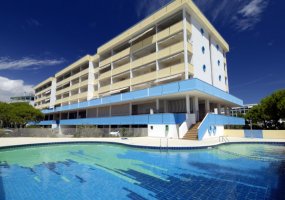
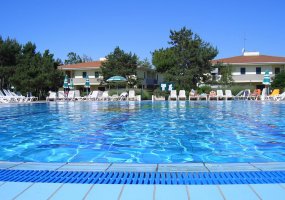
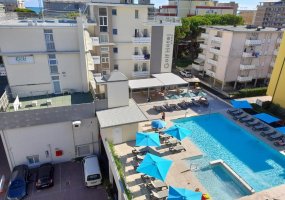
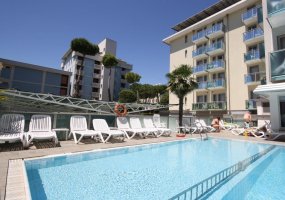
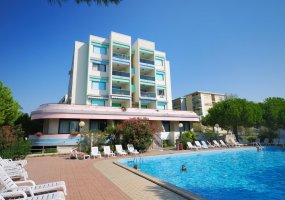
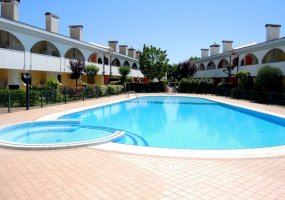
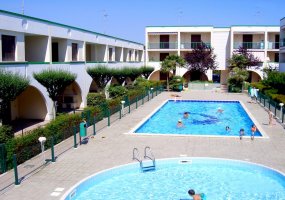
Now we can admire Bibione in all its beauty thanks to the attention to every single detail. Safe bike paths extend throughout the area, seafront hotels with pools and beachfront hotels offering a wide range of amenities to meet every guest's needs, elegant and modern apartments, wellness treatments at Bibione Thermae, restaurants, bars, clubs for young people, and shops for shopping enthusiasts, not to mention the excellent beach services. Bibione is a seaside resort to discover and love.